
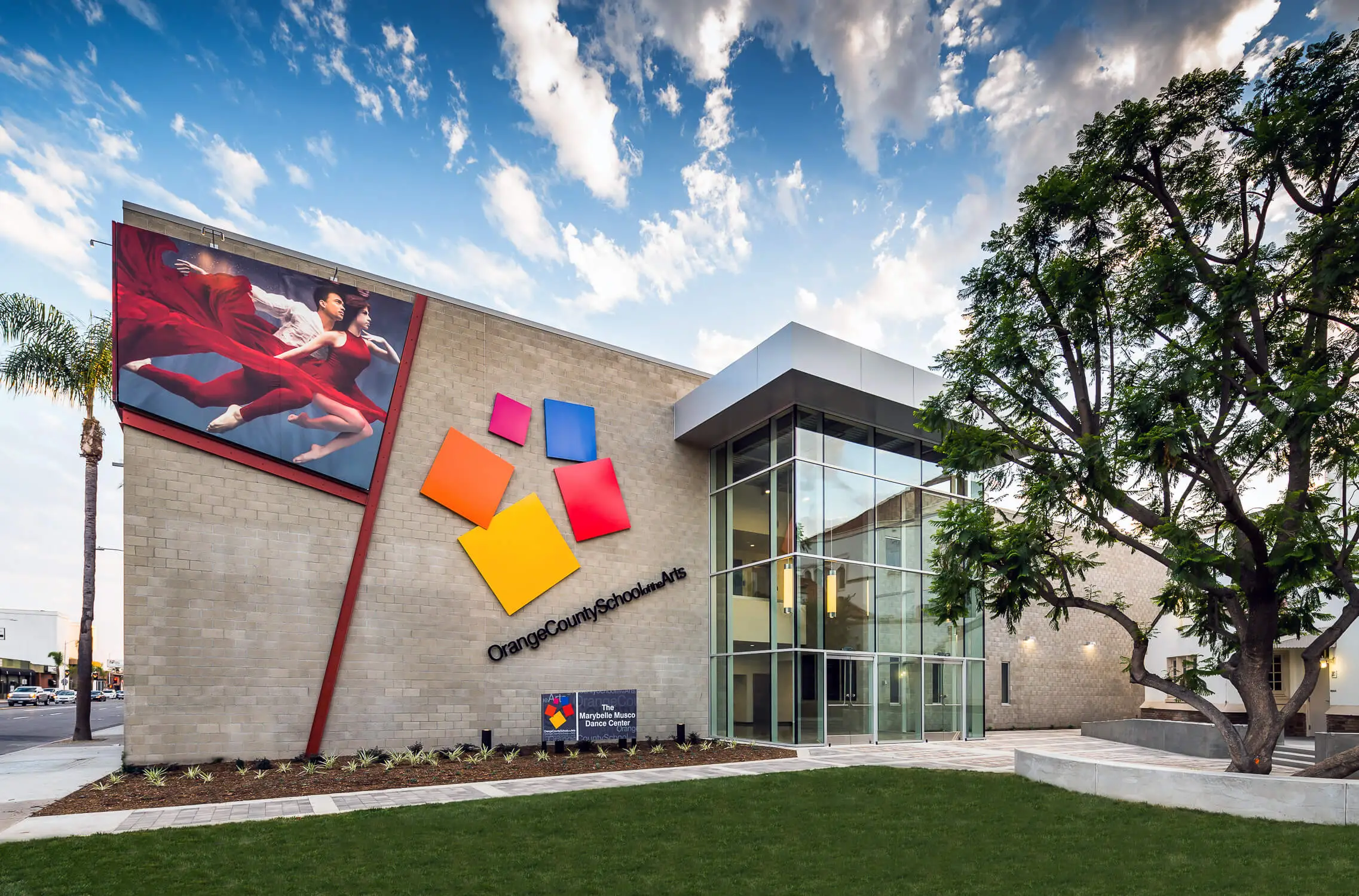
We interviewed Patrick Williams, the director of Orange County School of the Art’s Design and Media Conservatory, to ask about all things art. See below for his bio and interview.
About Patrick Williams
Patrick Williams earned his bachelor’s degree in illustration design from Art Center College of Design and his master’s degree in drawing and painting from California State University, Long Beach. He actively pursues his own creative artwork and was an adjunct faculty member at Orange Coast College.
Mr. Williams has dedicated his career as an arts instructor to creating transformative and empowering opportunities for young artists through education. He began his teaching at Orange County School of the Arts in 1999 in the school’s elective program and Visual Arts Conservatory before being named the Director of the Design & Media Conservatory in 2012. Mr. Williams is now credited for creating one of the most innovative high school digital media programs in the country.

Q&A
Q: What are some elements of storytelling that are more accessible to the graphic form than a text novel?
A: “I think there’s a couple things that comics do better than other mediums. One of them is temporal jumps; the ability to move from one location and one time period in one panel to another time period in another. Another thing I love about comics too is that you can have multiple narrative threads happening just in one panel. You can give multiple points of direction for each character, just in the context alone.”
Q: What’s the coolest use of visual storytelling you’ve seen?
A: “Kevin Huizenga has a graphic novel called ‘The River at Night.’ There’s some really interesting narrative devices. If I remember correctly, it’s about a guy who has insomnia so his mind is running. He’s thinking about everything from what’s happening outside his window to deep time. It’s sort of illustrated in this graphic novel space in a really novel, interesting way. It’s a story about nothing but the way it plays out is very interesting.”
Q: What are some of your own personal projects?
A: “I just make things. I’m one of those people who have a need to make a thing, and then when I’m done I need to make a new thing. Probably the most interesting would be a series of short, ten page stories. The whole idea behind it came out of a time I was walking my dog. I was trying to look at a list of the best graphic novels of the year and made a typo. I typed something like, ‘the best graphic novels of 2047.’ So I started thinking about what those stories were. Then I just went into writing a bunch of little, sci-fi stories.”
Q: As a director at an arts school, you’ve probably had to offer a fair share of mentorship to young creatives. What’s the best piece of advice you could give to someone getting into graphic novel creation for the first time?
A: “I think it depends on what side they’re coming from. If you’re coming from the visual side, I try to convince all our artists that they have stories to tell. They don’t need someone to write it for them. I try to challenge kids to figure out what story they want to tell and then tell it from their unique perspective. Having looked at a lot of comics, I think some of the more interesting ones are kind of hideous. That’s what gives them their own voice visually–is that it’s not perfect. Just make the thing.”
Q: Let’s say you’re at your favorite bookstore, browsing through new releases. What catches your eye and makes you immediately want to buy the book?
A: “Probably something by someone I didn’t know was releasing a book. Those are the things that get me really excited. There’s something about that work I was interested in before, and now I get to see what they’re doing now.”
Q: A lot of artists have spoken about having something called “Same Face Syndrome”—being unable to draw characters that look and feel distinct from each other. What are your best tips for unique character design?
A: “When I design characters, I start out by thinking about shape language. The more you draw those characters next to each other, I think they just kind of homogenize. One of the things that I do is have a printout above my drawing table. Then I can look up and realize ‘Oh yeah, this is way off.’ It’s just a process of homogenization that happens. Making someone look kind of funky is what makes them unique. I push features because I think it helps communicate aspects of the characters.”
Q: What graphic novels do you find the most well crafted? What was it in particular that made them so appealing?
A: “One that really blew my mind was one by Reina Telgemeier and Scott McCloud. It’s called the Cartoonist Club, and it’s about these middle schoolers who make a club where they make comics. The whole book also teaches kids about how to make comics, all the different types of comics, and the mechanisms of comics. So it’s this teaching tool that ‘hides the vegetables in the ice cream.’ It’s one of those things where I read it and got chills.”
Q: When working on creative projects, how do you motivate yourself to finish work before deadlines?
A: “When I’m working in the last stages of finishing something, my brain starts coming up with all these good ideas. It’s all these really good things that are really enticing. I’ve learned this trick where I just write it down. Write it down, do a doodle, and then go back to working. Just capture it so you know it’s safe some place and can go back to focusing.”
Q: How has other media like film, games, or even literature influenced your artwork? How might other artists do the same?
A: “When I’m writing a script and translating it to visuals, I think through the frame of a TV. I think, ‘How do I want to frame this composition? Where are my panels?’ I think about how you would through the lens of a camera. I totally think about it through the perspective of storyboarding and then tweak things to fit on the page. In general, films influence me pretty heavily.”
Q: How has teaching art changed your own creative outlook?
A: “The cool thing about teaching is that it’s made me more reflective. Sometimes, in the back of my mind, the ‘teacher voice’ kicks in. I’ll think, ‘How would I teach this to somebody? How would I justify my decisions in making this the way that I’ve made it?’ Getting to watch the struggles that young people have made me gentler on myself. If I was just in a studio by myself, I’d be less aware of how everybody struggles. Everybody hits those same points where they just struggle. Being in this space and watching young people contend with that has given me so much more perspective.”
Thank you to Director Patrick Williams for this interview. Hearing your input about the creative process and visual storytelling was very enlightening, and I’m sure our readers will think the same. We look forward to working with you more on KidLitGN!
Learn more about OCSA’s Design and Media conservatory here.