
Note: Only 7 weeks until KidLitGN’s pitch event opens for agents, editors, and publishers to view. GN creators you can load your pitches as soon as 8 a.m. EDT on Oct. 3 until 11:59 EDT on Oct. 7.
Agented creators–take advantage of the agented sections. Agents, encourage your clients to use the agented section. We’ve had several high profile editors follow us on social media, and we get editors and publishers coming to our pitch event every year. The agented section remains under-utilized.
And writers-only, remember, you can add a note that you are open to collaborations so illustrators can also peruse the pitches and connect with you.
Spread the word! The more pitches we have, the more we attract agents and editors, and that benefits everyone pitching.
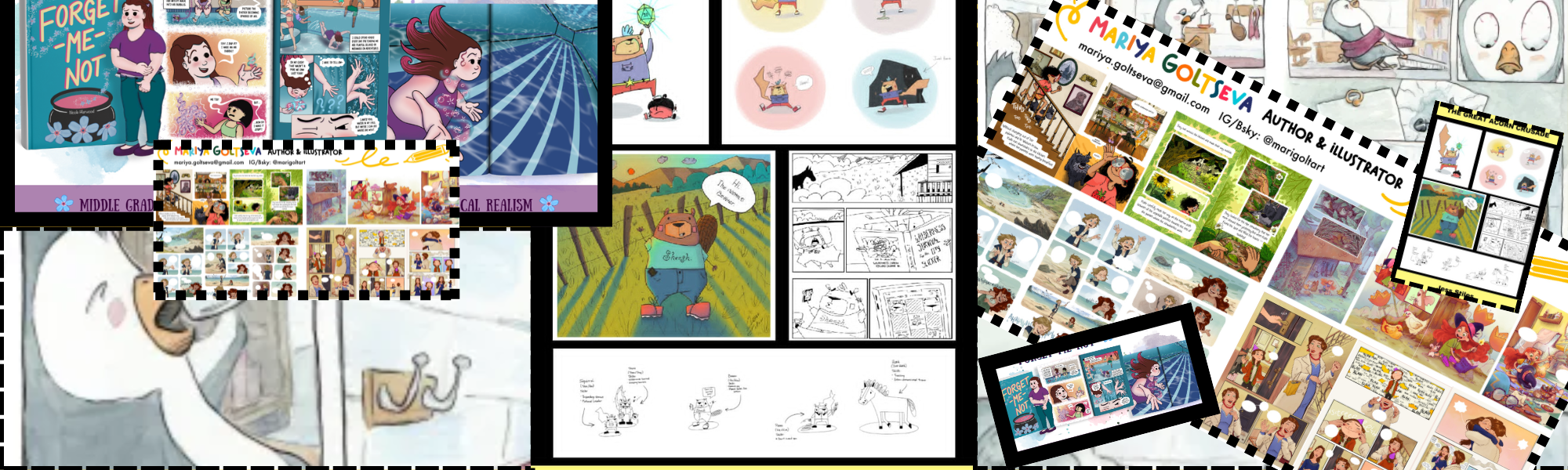
One of the most common questions we get from illustrators each year is how to best format the art file that goes with the pitches. A few GN creators shared art files from past pitch events that attracted agent or editor interest. Of course, you don’t have to use their formats, but hopefully these examples will give you an idea of formats that have worked before.
MG project created in Canva by Nicole Harwood. Connect with Nicole via website, BlueSky, or IG.

2024 Art File
Tips from Nicole: The first time I participated in the KidLitGN pitch event in 2024, I shared a simple graphic with a cover design, three inner pages and some keywords. It was fine. But not as visually appealing as what I used in the 2025 KidLitGN pitch event. Since it didn’t get any interest the first time, I considered not pitching it again. But, I love the story, and I knew I could make something that “sold” it better. Utilizing actual book spread templates in Canva made a huge difference in the visual appeal of my graphic. With a reworked synopsis, and an improved graphic, I was able to walk away from last year’s event getting a request.My biggest take-away was focusing on the visual appeal and using spreads that make people want to know more.

2025 Art File
MG GN project created by Jess Stiles in Clip Studio Paint. Connect with Jess via website or IG.
Tips from Jess: I created my pitch sheet in Clip Studio Paint and tried to keep it simple while showing a little bit of everything. Since graphic novels are such a visual medium, I wanted agents and editors to be able to quickly see the characters, the world, and how the story would look on the page. I included character sketches, a character spotlight, a finished illustration, black-and-white comic panels, and a few scene snippets to show both the art style and the storytelling side of the project.
When I was putting it together, I wanted the sheet to give a sense of the humour, adventure, and personality of the characters while also showing that I could handle sequential storytelling, not just standalone illustrations. My goal was to create something that felt fun, easy to scan, and hopefully left people curious about what happens next in The Great Acorn Crusade.
MG GN project created by Cesar Lador, formatted in Photoshop. Connect with Cesar via website, BlueSky, IG, or Facebook.
Tips from Cesar: I would suggest to showcase art that you love that makes you happy, because you might end up working on this specific story A LOT, so you better enjoy the story, its character and associated technique! If you end up getting a contract for a graphic novel, you are going to spend hundreds of hours on it so you better be enjoying yourself!
Also try to showcase art that the audience would want to know more about, maybe introducing an interesting character, or an unusual environment so the audience would be asking themselves, what is happening next? I WANT TO KNOW MORE!!! You are trying to hook the viewer at first sight! The spread I submitted was exactly that, introducing a character in a cozy environment, getting ready to go on an adventure. This spread was drawn and painted traditionally by hand with inkpens and watercolors, then formatted in Photoshop.

MG project created by Dan Haring in Photoshop. Connect with Dan on IG, and IMDB.
Tips from Dan: For this project I already had about 25 pages of sequential art completed. The trick was finding the right pages that would hopefully create interest. In the end I chose the pages I did because they introduced some of the fantasy elements of the story, as well as a bit of the dynamic between the main characters. My goal was to create something that would make the reader interested in continuing on with the story, while showcasing some of the art and storytelling.
Character sketches and other art can be helpful to include, but I think it’s most important to have some polished sequential pages that show your visual storytelling skills.
I draw digitally in Photoshop on a Cintiq, and I tend to make my files quite large. For this submission it was a matter of reducing their size and combining them into something that fit the guidelines.
Remember, you can pitch up to three (different) projects across any age category. If you are an illustrator, and don’t have a project to pitch, you can use the agented or unagented illustrator section to pitch yourself and a sample of your portfolio. If you pitch a project(s), you cannot also pitch in the illustrator section, and vice versa.
Mariya Goltseva‘s art file from last year is an example of a portfolio pitch that received agent interest:
Connect with Mariya via website, BlueSky, or IG.

Tips from Mariya: If I had any advice for creators participating, it is to have 4-5 polished sequential pages and then to have a well-written and detailed synopsis/outline or chapter-by-chapter breakdown, as that’s what the editors and agents will be asking to see in the actual query.
I prepared my pitch images in Procreate, my primary art software. I also use Canva a lot and would recommend the free version to everyone. Affinity’s new free software is also great.
I create a large horizontal canvas where I put all my relevant images and text. Think bigger than A3 or thereabouts. Resolution set to 300DPI. I then upload my sequential images first. Always start with sequential art first, as that’s what everyone wants to see. I will play with the sizing of these images so that they’re clear, legible and concisely grouped. If I have some empty space left, I will add character sketches or story sketches.
I always add my name and surname at the top, my IG handle and a link to my portfolio, or email address. If it’s a GN pitch, a short elevator pitch is also good – the editor or agent might save a screenshot of your pitch, so you want all your important information to be in one place. Once I’m happy with everything, I compress my file using online tools so that my image is compliant with the upload requirements.
A big thank you to Nicole, Jess, Cesar, Dan, and Miriya, for sharing their successful art files. Good luck to everyone pitching this year. We have had several agents and editors follow us on social media, so we know word is spreading. Again: please spread the word about the pitch event. The more amazing pitches we get, the more editors and agents we get tuning in, and that does benefit everyone.
Stay tuned for some stellar posts coming up soon, including a chance to win prizes from HUION, Scrivener, and Clip Studio Paint. For the latest updates, subscribe to our website.