

 Jolene Gutiérrez is an award-winning, neurodivergent teacher librarian who has been working with neurodivergent learners at Denver Academy since 1995. Jolene writes for young readers and hopes her books will help some readers feel seen and will help others learn and grow in compassion. Jolene is an active member of SCBWI, part of the KidLitCollective group, and a co-creator of #KidlitZombieWeek and Picture Book Gold. Jolene is represented by agent Kaitlyn Sanchez and is the author of Unbreakable: A Japanese American Family in an American Incarceration Camp (Abrams Childrens, 2025, co-authored with Minoru Tonai), Mamiachi and Me: My Mami’s Mariachi Band (Abrams/Appleseed, 2025, co-authored with her son Dakota), The Ofrenda That We Built (Chronicle, 2024, co-authored with her daughter Shaian), Too Much! An Overwhelming Day (Abrams/Appleseed, 2023), the Stars of Latin Pop series (Rourke, 2021), Bionic Beasts: Saving Animal Lives with Artificial Flippers, Legs, and Beaks (Lerner, 2020), and Mac and Cheese and the Personal Space Invader (Clear Fork/Spork, 2020). Her books have been printed in 10 countries and 9 languages. Find her online at www.jolenegutierrez.com or on Facebook, X, Bluesky, Instagram, or Threads @writerjolene.
The following questions came from members of KidLitGN’s Facebook forum. Thank you to them and to Jolene for this insightful article.
Please tell us a bit about you and your experiences, as a librarian, with graphic novels.
In 1995, I started working as a teacher librarian at Denver Academy, a school for neurodivergent learners grades 2-12. At that time, our school library had a “humor” section that included collections of comic strips like Garfield, Far Side, and Calvin & Hobbes.
I learned of Art Spiegelman’s Maus I and Maus II and added them to our collection. One of our high school teachers began teaching Maus as a class novel, and our graphic novel collection continued to grow with books like Jeff Smith’s Bone series, Kazu Kibuishi’s Amulet series, and Raina Telgemeier’s books.
In the early 2000s, prior to Kazu Kibuishi’s and Raina Telgemeier’s books, I had a small handful of students asking for the Naruto series. I bought some. My students devoured them, and more than 2 decades later, they’re still devouring them. The graphic novel section of our library is the fastest-growing, most-circulated part of our collection, hands down. I don’t see that changing any time soon.
Why do you love them, or do you? What place do graphic novels serve in your library?
I DO love them, and I love to read them, too, with the exception of traditional manga because my brain struggles so much with right-to-left formatting.
I think some circulation statistics will help you understand the importance of graphic novels in our library. I switched library circulation systems a little over 10 years ago, so my statistics only go back that far. Still, they’re very interesting.
Looking at the top 50 titles from ten years ago, 14 out of the 50 titles were graphic novels.
Five years ago, 20 out of the top 50 titles were graphic novels.
Three years ago, 29 out of the top 50 titles were graphic novels.
And last year, 39 of our top 50 titles were graphic novels.
Graphic novels are a crucial part of my students developing a love of reading. I can’t emphasize that enough. My students are EXCITED about these books. Picture a lower school student jumping up and down and squealing, “I love the library! I can’t believe they have this book!” Imagine a high school student saying, “Oh, SWEET! You have this series?” They find books they WANT to read, and that’s a big deal because a large percentage of my students struggle with reading in some way.
Although some adults feel like graphic novels and other illustrated texts aren’t “real books” or “real reading,” I can tell you that they’re absolutely real. The excitement that my students exhibit for these texts is real and tangible. The fact that they’re taking in a story and learning and growing as humans and readers is real. And their love of these books is real. Graphic novels are an essential element of any well-rounded library collection.
What are your most requested/checked-out graphic novels? What graphic novel genres do kids like best?
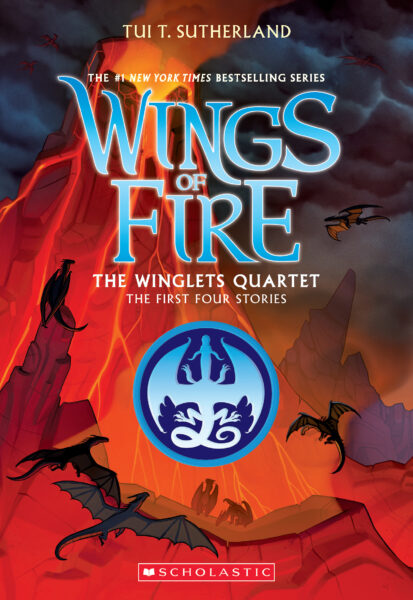
Manga tops our charts right now…since school started in mid-August, 9 of my top 10 circulations are manga-–books from the One Piece, Naruto, and Dragon Ball series. Other favorites are anything by Dav Pilkey, especially the Dogman series, anything by Raina Telgemeier, the Amulet series by Kazu Kibuishi, the I Survived graphic novels, George O’Connor’s Olympians series, the Wings of Fire graphic novels, the Science Comics series, and some of my history graphic novels, specifically World War II. My students love humor, action, and books that help them understand themselves and learn more about others.
What are kids asking for that’s not on the shelves? What do you wish you had in graphic novels but don’t yet?
That’s a great question! I feel like they can never get enough humor, action/adventure, or friendship/identity books. Some of them say they want more horror/scary stories, although they tend to get scared and tell me they have nightmares more frequently with graphic novels than with horror chapter books (and don’t get me wrong, I LOVE horror, but I think it’s tough in a visual format for some sensitive souls). I love the variety of “slice of life” graphic novels that exist in the world, but I’d love even more diversity–socioeconomic, mental health, gender identity, learning differences, cultural, physical differences, etc.
How do you use graphic novels to reach different kinds of students? What types of graphic novels have you seen work best for different kinds of students?
Some of my students struggle with visualizing stories. I do, too, to a certain extent, so the visual support of a graphic novel can be really helpful. Many of my students who are reluctant readers are drawn to graphic novels (no pun intended)–perhaps because of the visual support, perhaps because they’re beautiful, and/or perhaps because they allow kids to feel like they’re “cheating” a little. I’ve seen the same thing with Choose Your Own Adventure books and verse novels. Any time my “reluctant” readers feel like they’re getting away with potentially reading less, they hop on that opportunity. 🙂
Students who are artists love graphic novels. Students who are learning the English language love them because of the visual support and context clues. Students who struggle with choosing their next book and have anxiety around the plethora of options love finding a series, and graphic novel series are wonderful for that. Graphic novels can be really helpful for social emotional learning, too. Autistic readers and/or students who struggle with social skills are supported by the illustrations and can see things like facial expressions, conversation scripts, and body language in response to different situations.
What kinds of challenges to books are you seeing that specifically target graphic novels? Is this affecting your purchasing decisions?
I am SO fortunate to be at a school with a head of school who stands firmly with me in the belief that students should have free access to books. Because many of my students have struggled with reading, most of their caregivers don’t care WHAT they’re reading, they just care THAT they’re reading. I’m so frustrated by the rash of concerted and egregious challenges that we’re seeing in what is supposed to be a nation that supports and believes in freedom of information and ideas, but it’s not impacting my purchasing. I buy what our students ask for, what I think they’ll ask for, and what I know they need.
That being said, there have been times when caregivers have approached me with concerns about books their child has brought home. I appreciate them, and I let them know that. I’m grateful for parents who are involved in what their kids are reading, and if there’s something that their child is bringing home that doesn’t feel like the right fit for their family, we can absolutely have that conversation. I believe in choice for families, but I don’t believe in taking choices away from all readers. I think because of those discussions, we’ve never had a book formally challenged. Even so, I have a selection/collection development policy for my library and a request for reconsideration process in place if someone does wish to challenge a book. The first step in that process is reading a work in its entirety.
I think the only real challenge to graphic novels in my library is parents not thinking they’re “real books.” That happens every now and then and I do my best to help teach them and show them the complexity and beauty that can be found in graphic novels.
In answering this question, I searched for lists of frequently-challenged graphic novels. When I saw Gender Queer on a few lists, I thought of one of my students. During the pandemic, students couldn’t come into our library, but they used our online catalog to place holds on items and I brought browsing carts of books to classrooms. I knew from what they had told me, one of my students was figuring out their gender identity, so I shared Gender Queer with them. I know now from some of the things they’ve shared with me since that we could say that book might have saved their lives. That’s the power of seeing yourself in a book: suddenly, you’re not alone.
Are there any titles you love that you wish would get checked out more?

We have a nonfiction graphic novel section and some of our students love them, but I would like to see more of them circulate. And some of my personal favorites that I think don’t get enough attention in our library (but I try to talk them up and change that) include This Was Our Pact by Ryan Andrews, Snapdragon by Kat Leyh, Salt Magic by Hope Larson and Rebecca Mock, Invisible by Christina Diaz Gonzalez, Northranger by Rey Terciero and Bre Indigo, New Kid by Jerry Craft, Rapunzel’s Revenge by Shannon Hale, Dean Hale, and Nathan Hale, Artie and the Wolf Moon by Olivia Stephens, Estranged by Ethan Aldridge, and the Twilight Zone graphic novel series.
What upcoming titles are you and your patrons most excited for?
Some of the books I can think of right now that I know students have asked about include Dogman #13, the upcoming Warriors graphic novels, The Cartoonists Club by Raina Telgemeier and Scott McCloud, Dream On by Shannon Hale and Marcela Cespedes, any upcoming I Survived graphic novels, George O’Connor’s Asgardians series, and any and all new manga.
You can find Jolene’s book here: https://bookshop.org/
 You can connect with Jolene at:
Website: jolenegutierrez.com
Facebook: facebook.com/
Instagram: instagram.com/writerjolene
Twitter/X: twitter.com/
Jolene is so talented. I love getting to know her more through this interview. ❤️
You are SO kind, Elizabeth–I appreciate you! <3
Jolene is just awesome…both as an author and a librarian!
Teresa, you’re the best! Thank you so much! 💖
priceless librarian insight
Thank you for the amazing circulation statistics and even more reasons to love graphic novels and the value they bring to children’s literature!
Wow, this was such a great post! Thank you for sharing how a book helped save a child and all this great info. I love that Snapdragon is on your list of books you want kids to read more. Do you have Invisible Emmie and that series? Gosh, it’s so good!
Thanks for sharing this boots on the ground perspective, Jolene. Also wonderful that you are supporting ND learners.